Jigsaw Puzzle Tips: What Order to Build and How to Solve Same-Colour Areas
Start with the edges, sort by colour, and sort same-colour areas by shape. This guide shows how good puzzlers work, with diagrams. It covers areas full of look-alike pieces such as sky or plain colour, getting ready for 1000 or 2000 pieces, and how many pieces to start with. The tips work for paper puzzles and online ones. A 1000-piece puzzle takes about 10 to 20 hours to finish. At 2 hours a day, that is about a week (5 to 10 days).
5 tips to learn first
- Start with the edge pieces. Collect only the pieces with a straight side and build the frame first.
- Sort into piles by colour and pattern. Group similar pieces together: sky, buildings, trees, people.
- Start with the parts that stand out. Lettering, faces, lines and places where colours meet are clues. One such piece tells you where it goes.
- Sort same-colour areas by shape. Sort by how many tabs and holes a piece has and how they are arranged. You will have fewer pieces to try.
- Keep the box picture in view. Compare each piece with the picture to decide which area it belongs to.
What order to build
Whatever the picture, this order makes it hard to get lost.
Spread out all the pieces, face up
Pieces that are face down or stacked will cost you time later. Take the time at the start to spread them out so every picture side shows. It is the fastest way in the end.
Collect the edge pieces and build the frame
An edge piece has 1 straight side. A corner piece has 2. Once the frame is done, the picture's size and direction are fixed, and you can roughly tell where the other pieces go.
Sort into piles by colour and pattern
Sort by look: sky, sea, buildings, trees, people. As you sort, check the box picture to see where each colour belongs. Put each pile beside the frame, at the same height as its part of the picture. That saves carrying pieces across later.
Start with the parts that stand out
Begin with pieces that tell you their place on their own: lettering, faces, windows, straight lines, the line between sky and mountain. When you have a small cluster, place it inside the frame where the box picture shows it.
Match what is left by shape
What remains is usually look-alike pieces such as sky or sea. Here you search by shape, not colour. The next section explains how.
Tips for same-colour areas like sky and sea
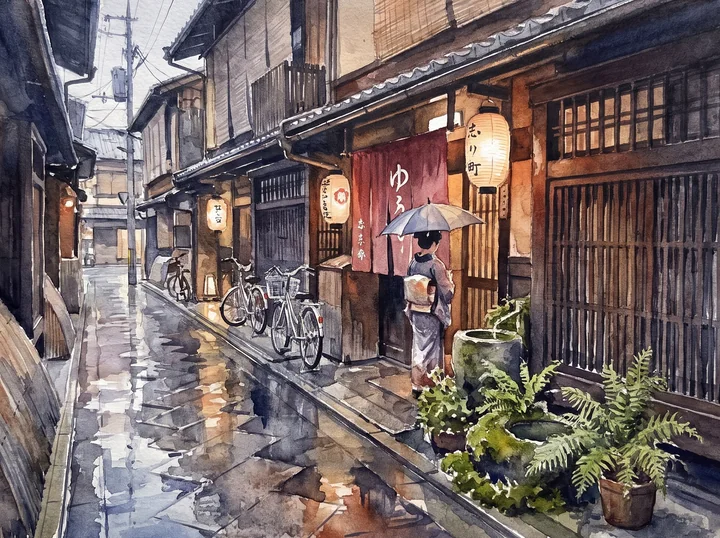
What takes the time is not the number of pieces but how many pieces look alike. In "Sea and Sky Gradient" below, most pieces have a near-twin somewhere else. "Alley After Rain" has almost none. With the same number of pieces, the time can be very different.

Sort by tabs and holes
Each of an inner piece's 4 sides is either a tab that sticks out or a hole that goes in. Sort by the number of tabs and holes and how they are arranged, into the 6 types in the diagram below. Then you never try a piece whose shape cannot fit the gap.
If nearly all have 2 tabs and 2 holes, sort by tab size
In some puzzles, most pieces have 2 tabs and 2 holes on opposite sides. Sorting by type then barely shrinks your piles. So split them further by the size of the tabs, the narrowness of the necks and the curve of the sides.
Count the edges to get rows and columns
Once the frame is done, count the pieces along the top edge and a side edge. A 1000-piece puzzle might be 40 across by 25 down. When you know how many rows and columns of sky there are, you can roughly tell how many pieces remain and where they go.
Fill one row at a time along the frame
Fill sky and sea one row at a time, working out from the frame or a finished cluster. Two sides of each gap are already set, so fewer shapes can fit. The trick is not to start an isolated spot in the middle.
Line pieces up the same way and try only shapes that fit
Lay out your sorted pieces all facing the same way. First check whether each side of the gap needs a tab or a hole, then try only pieces of that shape. You will find the match much faster than by trying them all in turn.
Look for slight changes in colour
A sky is often darker at the top and paler at the bottom. A sea changes colour near the horizon. Even what looks like one colour shifts little by little. Line pieces up from dark to light and you can roughly tell their height.
Look at brush strokes and the direction of clouds
In a painting, brush strokes are a clue. In a photo, look at the direction of clouds and ripples. In a picture with clear brush direction, such as a Van Gogh sky, even the same blue is easier to tell apart.
Tips for plain and all-white puzzles
An all-white puzzle or a puzzle in a single colour has no colour clues at all. Shape is all you have. Start from sorting by shape, as in the last section, and add the steps below.
Get bright light and a dark mat
With a white puzzle, build on a dark mat or board so the piece edges and gaps show clearly. To avoid shadows, light it from directly above or diagonally from the front.
After the frame, sort into smaller piles than usual
On top of the 6 types from the last section, sort by tab size and neck width as well, and make lots of small piles. You cannot sort by colour, so the smaller the piles, the fewer pieces you try.
Look at the shape of the gap, then find the piece
With a white puzzle, the gap made by the surrounding pieces is itself the clue. Check whether it needs tabs or holes, then search only the pile of that shape.
Shine a light from the side and compare the sheen
Even on a plain puzzle, light from an angle can show small differences in surface sheen and cut edges. That can settle it when you are stuck.
Do not force pieces, and take breaks
A piece pushed in by force can look right and still be wrong. If it does not slide in easily, try another. A break every 30 minutes to 1 hour means fewer missed fits.
Building 1000 or 2000 pieces
With a big puzzle, it helps to settle your space and your plan before you think about technique.
Clear a space a little bigger than the finished size
Common finished sizes are about 50×75 cm for 1000 pieces and 73×102 cm for 2000 pieces. Puzzles with small pieces can be 38×53 cm or 26×38 cm even at 1000 pieces, so check the box. You also need room for your piles, so a space a little bigger than the finished size is safest.
Make sure you can put it away part-way
It will take days. If you build on a dining table, use a puzzle mat or board so you can put it away unfinished.
Sort piles into box lids or shallow dishes
Keep each colour pile in a box lid, shallow dish or tray. They take up less room and the piles do not mix.
Stand the picture up where you can always see it
Prop up the box picture where you can see it just by looking up. Picking it up less often makes a big difference.
Set a goal for each day and go little by little
Set goals like "the frame today" or "the left half of the sky today". They make it easier to keep going however many days it takes. A 2000-piece puzzle often takes several times as long as a 1000-piece one, so it is easier to plan by the week. The table in the next section gives rough times.
To display it, get a panel and puzzle glue
To display a finished puzzle, use a panel (frame) that matches its finished size, and glue made for puzzles. Follow the glue's instructions for how much to use and how long to let it dry.
How many pieces should a beginner start with? How long does it take?
If you are buying your first paper puzzle, about 300 pieces is a good choice. It takes a few hours, so you can try the whole routine of edges first and sorting by colour from start to finish. When you are used to that, move up to 500 pieces and then 1000.
- Pick a busy picture with clearly separated colours. Pictures with lots of colour and pattern, such as buildings, flowers or street scenes, are easy to sort into piles, so even a first-timer makes progress. Save pictures with wide skies or seas, and gradients, until you have more practice.
- Check the piece size too. At the same piece count, small and micro pieces are tiny and harder to tell apart. For a first puzzle, regular-sized pieces are best.
| Pieces | Rough time to finish |
|---|---|
| 300 pieces | About 1 to 3 hours |
| 500 pieces | About 5 hours |
| 1000 pieces | About 10 to 20 hours |
| 2000 pieces | Dozens of hours (one guide says about 60 hours) |
These are rough times for paper puzzles (from Sakidori's guide). Another guide puts 1000 pieces at 12 to 20 hours for a first-timer and 5 to 8 hours for a very experienced puzzler (eeBoo). The picture matters a lot too: the wider the sky or sea, the longer it takes.
Practising online
To try these tips in a short time, an online puzzle is an easy option. The table below shows solo plays on Puzzle Lounge from 24 October to 3 November 2026. Times vary a lot from person to person, so it gives the median (the time of the person in the middle) and the range that half of players fall into.
| Pieces | Time to finish (median) | Range for half of players | Times finished |
|---|---|---|---|
| 48 pieces | About 5.5 minutes | About 4 to 7.5 minutes | 39 times |
| 108 pieces | About 19.5 minutes | About 15 to 26 minutes | 295 times |
Sizes of 300 pieces and up are left out because only 2 plays were finished in this period.
- View the picture large. On Puzzle Lounge, on a computer, the Tab key shows the picture large, and you can also lay it faintly over the board.
- Start on Normal. On Normal, the pieces all face the same way. Once you are used to it, Hard turns the pieces in all directions and feels closer to a paper puzzle.
Is it faster with other people?
Yes, if you split the work. One person takes the edges and the others each take a colour area such as sky or buildings. Then nobody reaches for the same pieces.
On Puzzle Lounge you can build the same board online with friends. There are only 9 finished plays of 108 pieces with 2 or more people so far, so take it as a rough guide. Their median was about 13.5 minutes, faster than solo play (about 19.5 minutes).
Frequently asked questions
How many pieces should I start with?
For a paper puzzle, start at about 300 pieces, then move up to 500 and 1000.
How many hours does a 1000-piece puzzle take?
About 10 to 20 hours. One guide says 12 to 20 hours for a first-timer and about 5 to 8 hours for a very experienced puzzler.
I am stuck on areas of one colour, like sky or sea.
Sort the pieces by how many tabs and holes they have and how they are arranged, not by colour. Then try only the shapes that fit the gap.
How much space do I need for 1000 pieces?
Most finish at about 50×75 cm. You will put piles around it, so a space a little bigger than that is safest.
How do I build a plain or all-white puzzle?
Work on a dark mat. Sort finely by shape type and tab size, and search only the pile that matches the shape of the gap.
Why start with the edges?
They are easy to find, and a finished frame fixes the picture's size and direction and the number of rows and columns.
Try it now
Puzzle Lounge's jigsaw puzzles are free, with no sign-up needed. Start with a picture that has few look-alike pieces and these tips are easier to try. "Alley After Rain", for example, has almost none.
Sources
- Puzzle Lounge play records (24 October to 3 November 2026. Of about 470 solo plays, the 336 that were finished: 39 at 48 pieces, 295 at 108 pieces, 2 at 300 pieces. Of about 20 group plays, the 9 finished at 108 pieces.)
- Puzzle Lounge's measurement of picture difficulty (477 pictures, share of look-alike pieces)
- Sakidori, "Recommended Jigsaw Puzzles" (rough times by piece count)
- eeBoo, "How long does it take the average person to do a 1000 piece jigsaw puzzle?"
- It's Puzzling, "Solving One Color" (how to build plain puzzles)
- Finished sizes: as printed on products from Yanoman, Tenyo and others (for example, 1000 pieces 50×75 cm, 2000 pieces 73×102 cm)